In the event organized by Bilge İlahiyatler Club, our Rector Prof. Dr. Ozturk Emiroğlu held a comprehensive conference titled “The Question of the Bible”. The program started with Kur’an-ı Kerim tilavet after the reading of Respect Breakdown and Istiklal Maril; enriched with divine and poet listeners offered by students. “There is a spirit, an adventure and struggle like people, just like people.” Our Rector Prof. Dr. Ozturk Emiroğlu discussed the multi-layer structure of tradition, religion, culture and modernity at intersection points of the speech. With the adoption of the role of tradition in social continuity and identity building, he stressed that his sacredization process should be subjected to a critical assessment. He expressed that the tradition can lead to a number of destructions in religious, intellectual and moral areas by removing “natural and historical transfer. “Cutsality is natural; it carries itself in income and its own meaning. The tradition fights for sacrificing. This struggle has made the tradition of a social bond to an authority instead of the geleneği religion. A phenomenon that belongs to social life in the basis of the tradition, taking into account the sociological origins of the concepts, the sacred is a religious reference. It noted that these two areas are not mixed together, especially in modern period, religious practices, ceremonies and symbols cause loss of meaning. In his speech, our Rector, a conceptual comparison between Western philosophy, Christian tradition and Islamic thought, spoke to examples that the traditional structure is not only a specific case to the East societies, the similar processes are historically experienced in Western. In this context, Easter rituals and cultural practice presented a wide comparative analysis through examples that the dinine elements pass. Also, in the context of Turkish literature, the concept of “the sacredity of the tradition” was evaluated in the aesthetic plane. Prof. Dr. Emiroğlu, whose origin of modernization in Turkish literature, based on aesthetic fractures starting with Nedim, said, “The transition from tradition to modern, is not a value, but the rebuild of meaning.” With this direction, edebî tradition was a transformation and reproduction area like religious tradition
Prof. A Discipline Conference on “The Holyness of the Treaty” from Dr. Öztürk Emiroğlu
16 Ekim 2025
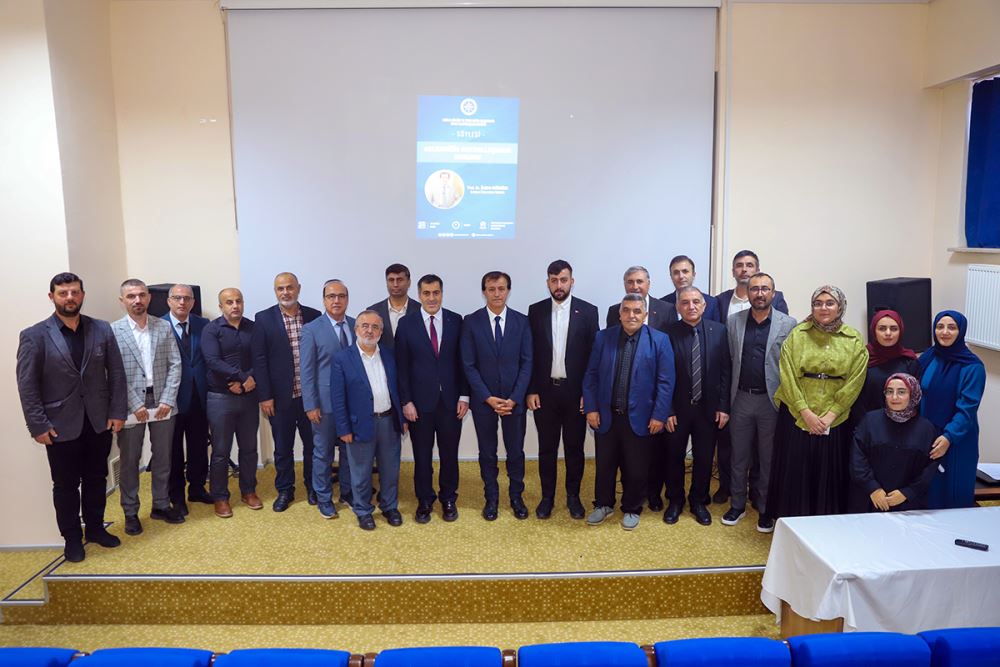
Photo Album
Click on a visual; in the pop-up window, switch to the previous / next arrows, ← → keys or other photos with scroll on the mobile.